Christine Shope
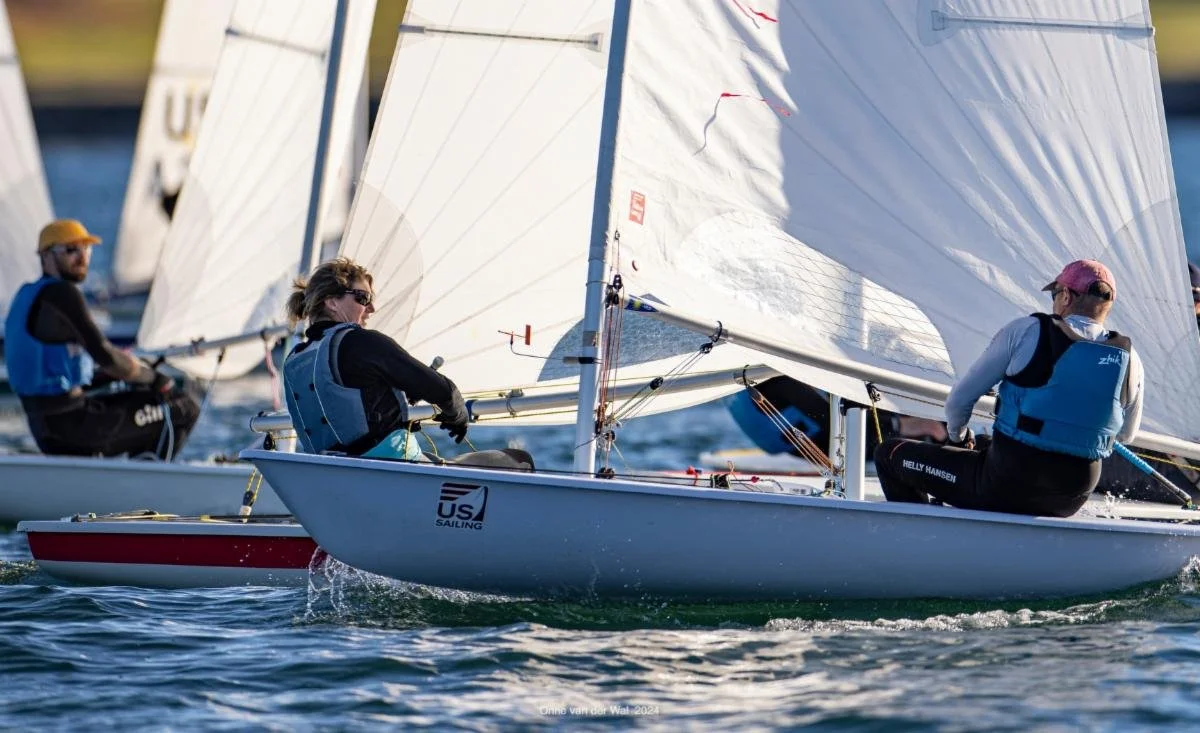
Here are three important things that helped win the day today, and that I can always work on doing better!
1 - Starting well - ish (or rescuing a bad one). As Peter Shope says 'winning the day is all about getting 6 decent starts'.
I wasn't perfect starting today, but managed 3 where I had a clean air lane as far as I wanted, and 2 that I was able to rescue with a couple tacks to get a lane. Here are some starting pointers:
The goal is to achieve a lane to sail in clear air heading the direction you want.
Full speed on the line at the gun is good. (use line sight and watch on mast)
Near the favored end is nice, but high risk.
Our frostbite starts are often congested, and moving to low density can be a good move, especially because high risk starts are a bad idea for a day of sailing with no throw-outs.
You need space to do a decent acceleration at 5 seconds (about 4 feet to leeward and 6 or more feet from the line) - either make it and maintain it, or steal it. Once you have your space, be vigilant to defend it and keep the space to leeward small so it doesn't look appealing to potential stealers.
Forward flow over your blades is what keeps you from sliding sideways and losing space to leeward. Once you get close to the line you will go sideways. Setting up farther back allows you to keep moving forward while protecting your space to leeward without going sideways.
If you lose the space you made, the earlier you bail out the better - 15 or 30 seconds to go is not too late. Back up, and either tack to port, or sail down the line toward the pin if you think there is a space there.
If you don't have a lane with clear air off the line the next move is to get on port ducking front row boats. Sometimes you have to wait for some second row boats to tack out before you can duck only front row boats, but don't wait long if you are sailing slow. If a front row boat tacks on your lee bow when you are on port, it probably just opened up a clean lane for you on starboard.
2 - Sailing in clean air - Especially in light air this is crucial.
3 - Looking for pressure and going there - After the start, this is the most important part of frostbiting, and we can always do it better. Don't forget to look over your shoulder to the other side of the course when you are sailing upwind, and when sailing downwind keep checking what's coming down the course by looking behind you and way upwind. Look upwind before approaching a mark rounding to decide which side of the course you like before you get there.
WOW for March 3, 2024
Often, a winning day feels like it was easy, or everything just falls into place. This happened to me on Sunday, and when leaving the IYAC after racing I mentioned to Aidan that winning the day was unexpected. He responded: “Does anyone ever expect to win the day?” While I won’t answer that question, here are a few things I have learned over the years from others or figured out for myself that help me attempt to achieve a successful racing mindset. They don’t guarantee anything, but sometimes work!
Try without trying - this is the goal, and the idea came to me from the Inner Game of Tennis book. It is also called achieving a ‘Flow State’. It’s easiest if you have a million hours of practice under your belt so you can do what you know without thinking about it, but you can also fake it by pretending to be one of your idols. Try watching a video of Tom Slingsby, or Lija Ju, then close your eyes and imagine you are them before you go sailing.
Eliminate your expectations of results - Even telling yourself ‘I just don’t want to get last’ is a results expectation. Be okay with losing. You can’t control how others sail, and they affect the results. Sometimes it helps to imagine yourself completely tanking, doing everything wrong to an extreme, and what the results would look like, then realize you would still be fine. When you make that realization, a weight will be lifted and you can open your mind to focusing on how to sail fast.
Focus on the task at hand - It could be start execution, boat speed, making a good tack, or looking for wind. Pick the important thing in that moment and focus 100% on that thing when you are doing it. This is where you try really hard - to focus.
Respect your competitors and the game - If you want your competitors to try their hardest and perform to their best to challenge you, and you try your hardest to beat them, you take your sailing to another level. Sportsmanship and mutual respect makes you feel good, try harder, and focus better.
Be happy - nothing opens your mind to performance and learning than enjoying being out on the water doing what we do. We are so lucky to be out there sailing with our friends in beautiful Newport harbor. Enjoy it, and you will be better able to make observations on the racecourse and learn and improve.
What won the day on Sunday? I got out early for once, and had time to do a split with Aidan which gave both of us confidence to go right on the first beat. I realized during the first race that the holes were big, and the key to the day was to avoid the holes, and stay in the pressure. How? I focused on looking upwind for breeze and putting myself there. Ferg would call it connecting the dots. Upwind and downwind. One thing laser sailors can’t do enough of is look behind them on the downwinds. Especially frostbiting. If you want to make instant improvements in your frostbiting results, get paranoid about looking behind you for pressure on the downwind legs.
