Mark Bear

Having been a member of this frostbite fleet for several decades, I was able to conjure up some memories of sailing in the conditions we had on Sunday from days gone by (a feat that is not assured at my advancing age). The course was set up for the easterly off of Ida Lewis, meaning that we would be spending most of the day sailing upwind into a pretty stiff ebbing tide. The temptation, which most of the fleet succumbed to, was to start near the boat end and work the right to get some relief from the current. However, there was a pretty decent line bias favoring the pin end, and more wind on the left.
Most of my success Sunday came from getting decent starts at the pin end (with the aid of a good line sight) and having the opportunity to tack and cross the fleet. It then became a game of fleet management. Although there was some current relief on the right, this did not offset the hazard of the effect of the shore on the wind— as one approaches the right shore line, there is often a geographical left shift and less pressure due to the diverging wind direction. That means if you go to the right side lay line, more often than not you’ll be coming back with less wind and in a header. I wanted to make sure I did not fall into that trap, so always hitched left at the top third of the beat to take advantage of the left shift coming in to the mark on port tack.
However, by race 5, the tide was starting to go slack and the mean wind direction went right, meaning that I needed a new strategy. Unfortunately, I was not very successful starting in the middle of the line in the last 2 races, and I found myself fighting from behind at the windward mark. I could see my good day slipping away, as it so often does. I was saved by being able to pass some boats downwind. The general principle was to keep looking behind to see where the next puff was coming down the course, and concentrate on using boat trim rather than rudder to steer the boat.
Happily, my finishes were good enough to hold off the young speedsters, Adrian and Noah, who finished second and third, respectively. Rounding out the top 5 were CJ Congrove and Robbie Scala, and if you’ve not been paying attention, these guys are getting better every week, with an increasing string of top-5 finishes. As always, a heartfelt thanks to our superb race officers, Cushing and Kelly. We are so lucky to have them.
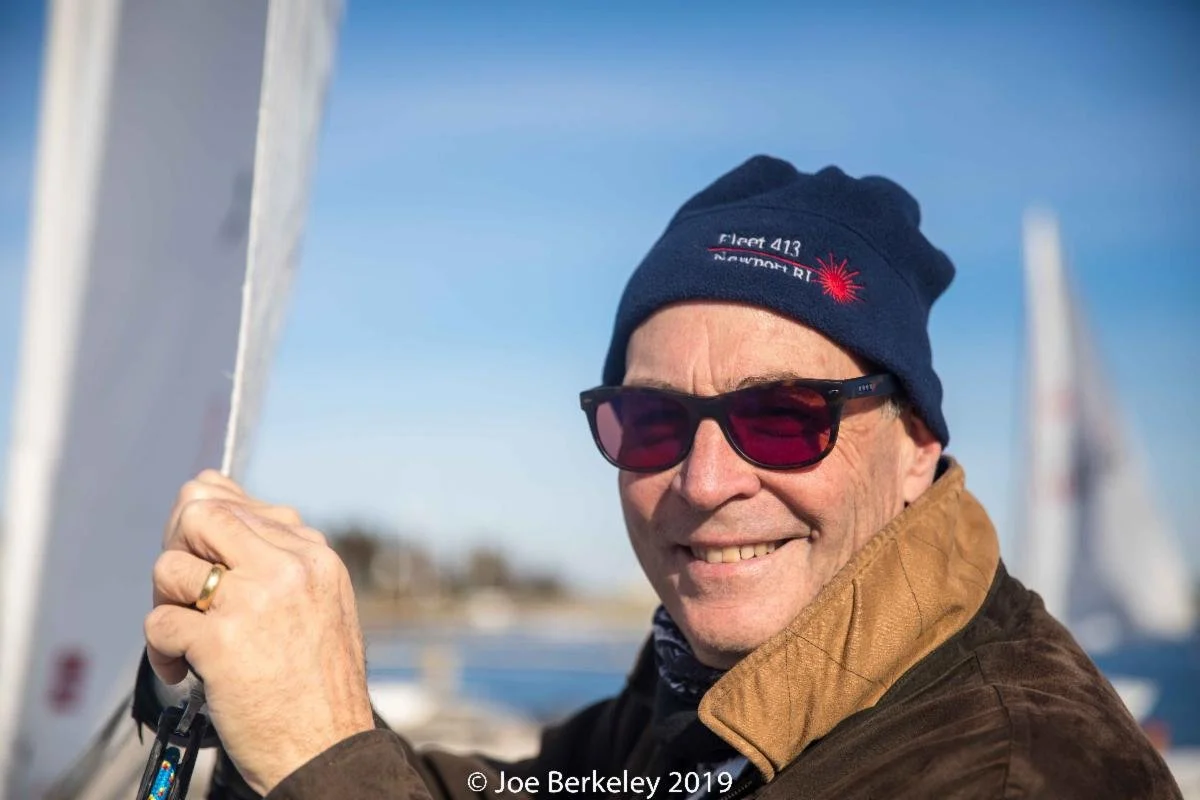
“Don’t think, just do.” That was the advice given to improve my mental game by multiple world champion Keith Wilkins. This advice was surprisingly easy to follow last Sunday, January 1. The combination of sleep deprivation and “dehydration” made thinking out of the question, so all I could do was, well, …do. The breeze was very unstable on Sunday, so the key was really being able to stay in the middle of the course (in the “cone”) so you could tack to take advantage of the shifts.
In the first race I ignored my previous word of wisdom and started right at the favored boat end of the line. It worked out OK, however, because I could hold my lane long enough to get to the middle, and then was able to tack on the first big header. I quickly realized that it was really shifty, and the shifts didn’t last very long. So all I did was tack on the headers to keep pointed toward the mark. I made a point to consolidate on every gain, by tacking to cross the boats on my hip whenever I could do it. This opened up a nice lead.
The second race I started towards the pin, which had been reset to be slightly favored. The danger with pin starts is that you can sometimes get “pinned” (bad pun) by the boats on your hip. Indeed I was, and I ended up being forced too far into the left corner. I recovered somewhat by sailing a long port tack hitch to get me back into the middle of the cone, below the mark. Then I could again take advantage of the small, rapid shifts to get back in the hunt.
In the third race, I did follow Ferg’s advice, and had a very nice start in the middle of the line. I looked over my shoulder and saw that I could cross all the boats on my hip, so I tacked to do so. I sailed on port into the next header and tacked back, now far above all the boats that had continued on starboard. Man, I felt like Stuart Walker!
In the final race I had a good start at the pin, and fortunately was able to tack fairly promptly — which was key since the breeze had gone back left, skewing the beat quite a bit. I worried about the next big righty doing me in, but fortunately it turned out not to be a one-tack beat, and I could still make some hay by tacking on the little flicks that went right. Only Scott Milnes made out by sailing into the right corner.
So, the keys to upwind success in very unstable wind (like Sunday, and typical when the breeze is light) are to (1) stay in the cone, (2) consolidate by tacking whenever you can cross. To execute, you need to get a decent start and hold a lane until you want to tack, rather than when you are forced to tack. Holding a lane on Sunday required that you keep the boat very powered up. Be alert to start easing stuff, like the cunningham, vang, and outhaul, whenever the breeze gets soft. Needless to say, try to resist the temptation to allow the boat to heel when it goes light — it feels good, but it is not fast. And, of course, don’t think too much.
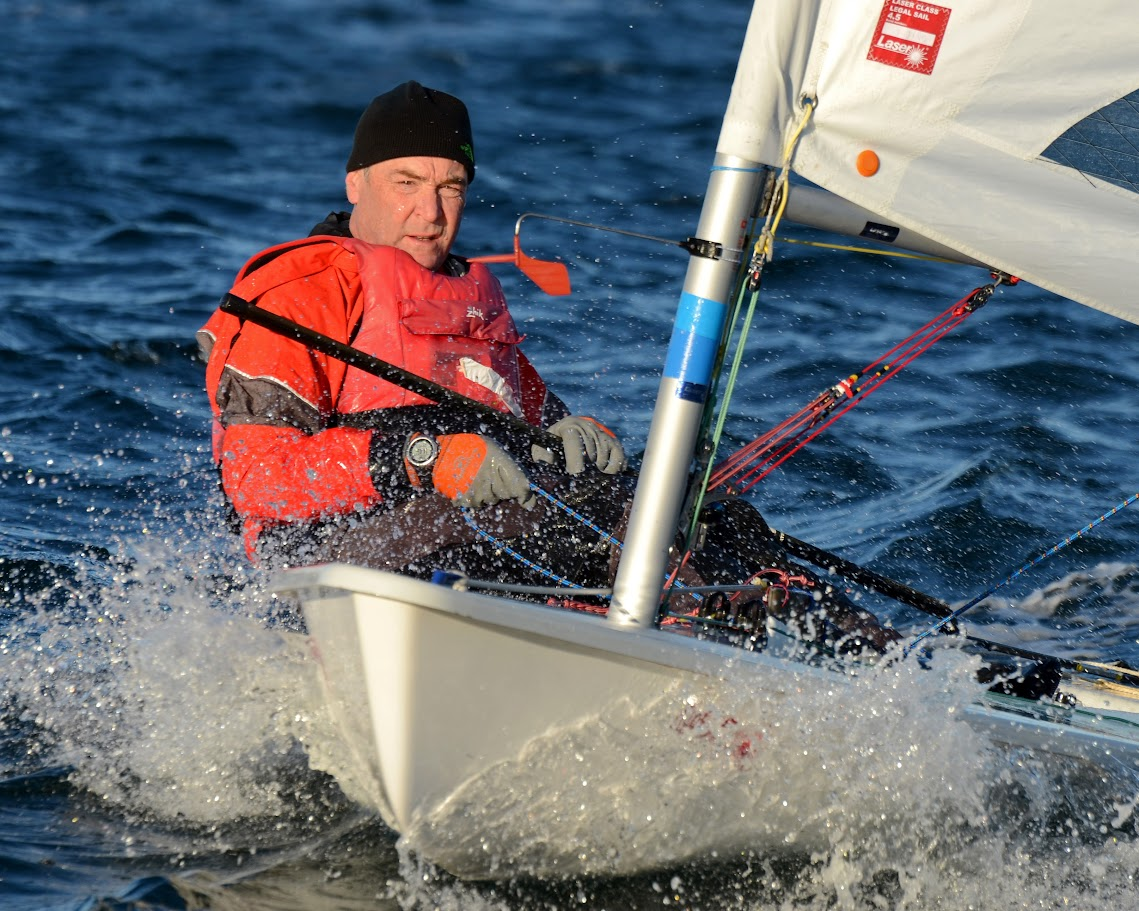
After a mediocre beginning to the day, I suddenly entered “the zone”, where everything seemed to go my way. I’m not sure how to get into “the zone”, but it sure is nice when you’re there.
One thing that influenced my sailing on Sunday was the winter Olympics. I was impressed by how such tiny mistakes in the giant slalom, like catching too much air, could cost the skier the few milliseconds that separated victory from defeat. Our finishes in frostbiting are also often separated by only a few hundred milliseconds, so I tried to be particularly conscious of how fast the boat was going and making continual adjustments to stay at maximum speed. In the first two races this paid off nicely downwind. In both races I started near the pin and got pushed too far to the left side of the course, particularly bad with the windward mark skewed so far to the right. I rounded in about 15th place in both races. In race 1 the downwind leg was a broad reach on starboard. I tried to emulate Scott Milnes, who is very fast on reaches, by making sure the boat didn’t heel to weather. To do that without too much weather helm, you need to pull the board up quite a bit. I sailed high and fast and was able to catch quite a few boats. In the second race, my comeback was to sail lower than the parade of boats in front of me, that were lined up along an arc to the right (everyone trying to reach over the boat in front). There was nice pressure on the left, and again I passed a bunch of boats. Nevertheless, the day was not off to a great start, with two 7th place finishes.
Then I entered “the zone”. The windward mark was moved dead upwind, just below Fort Adams, and the starting line was squared. I thought that because the beat was going to be short, and the wind very shifty off the shore, I wanted to start in a position where I had the freedom to tack when I wanted — that meant the boat end. Fortunately the boat end was not too crowded, and I was able to get very good starts the rest of the day. Then the trick was to hold on until the first header, tack, and stay on the lifted tack to the mark. I continued to stay focused on boat speed upwind, and continuously adjusted the vang, cunningham, and outhaul. We all pull this stuff on wind the breeze comes on, but often forget how important it is to ease it all in the lulls.
Another factor was the current, which changed about 1:45 PM so it was going left to right when looking upwind. That meant you had a “current lift” on starboard tack. The important thing to avoid under these conditions is over-standing the windward mark to starboard. When that happens, you’re not only sailing extra distance, but you’re going against the current to get back down to the mark. I made out in a couple races by tacking just inside of the first boat on the starboard layline. I relied on the current lift to get around the mark successfully. Risky, perhaps, but it worked great in the second half of the day.
A few words of wisdom (11/11/24):
First, I want to thank Dr. Scott Martin at MGH for repairing my quadriceps tendon. After 6 months of rehabilitation, it was awesome to be sailing again. If anybody needs a knee guy, he is your man. Second, thanks to Moose and Kelly for devoting their Sundays to us so we can go sailing. Can’t say enough about how lucky we are.
There were some upwind speedsters out there yesterday so I knew it was going to be a battle, and honestly I was surprised to have won the day. It has been a long time since my last win, and I must take the asterisk, since Mike, Steve, Christine and other luminaries were not sailing. But hey, I’ll take it. Here are a few observations on what worked:
1. Good starts yield good finishes. It was pretty easy to get a line sight yesterday, opening the possibility to start in the middle, near the favored end. I came in on port tack from the pin at about 1 minute and tacked onto starboard at about 30 sec. There was plenty of room to find a hole. Important to be mindful of current, which was flooding (taking us upwind) most of the day. Ideally you are set up so you can sheet in with 5 seconds to go and hit the line with speed.
2. Lot’s of gear shifting upwind. The breeze was very puffy, so it was important to adjust the controls to de-power and power back up. The Cunningham is the easiest adjustment to make. Put it on hard when you feel overpowered and have a lot of weather helm, and loosen when the boat goes flat when fully hiked.
3. In shifty conditions, a compass can help. Mostly the top sailors leave their compasses on shore when frostbiting because they can be a distraction, and you can learn as much about heading by looking around. However, sometimes it can be invaluable. Case in point was checking heading after rounding the leeward mark. I was able to make a long tack to the left pay on one final beat because I knew this was the lifted tack and it would eventually come back, which it did, allowing me to pass the leaders.
4. Downwind look behind. The gusts were very streaky, so keeping an eye on them was particularly important. There were some impressive shafts of breeze on the NYYC side of the course that occasionally justified heating up to a broad reach to get into.
