Ed Adams
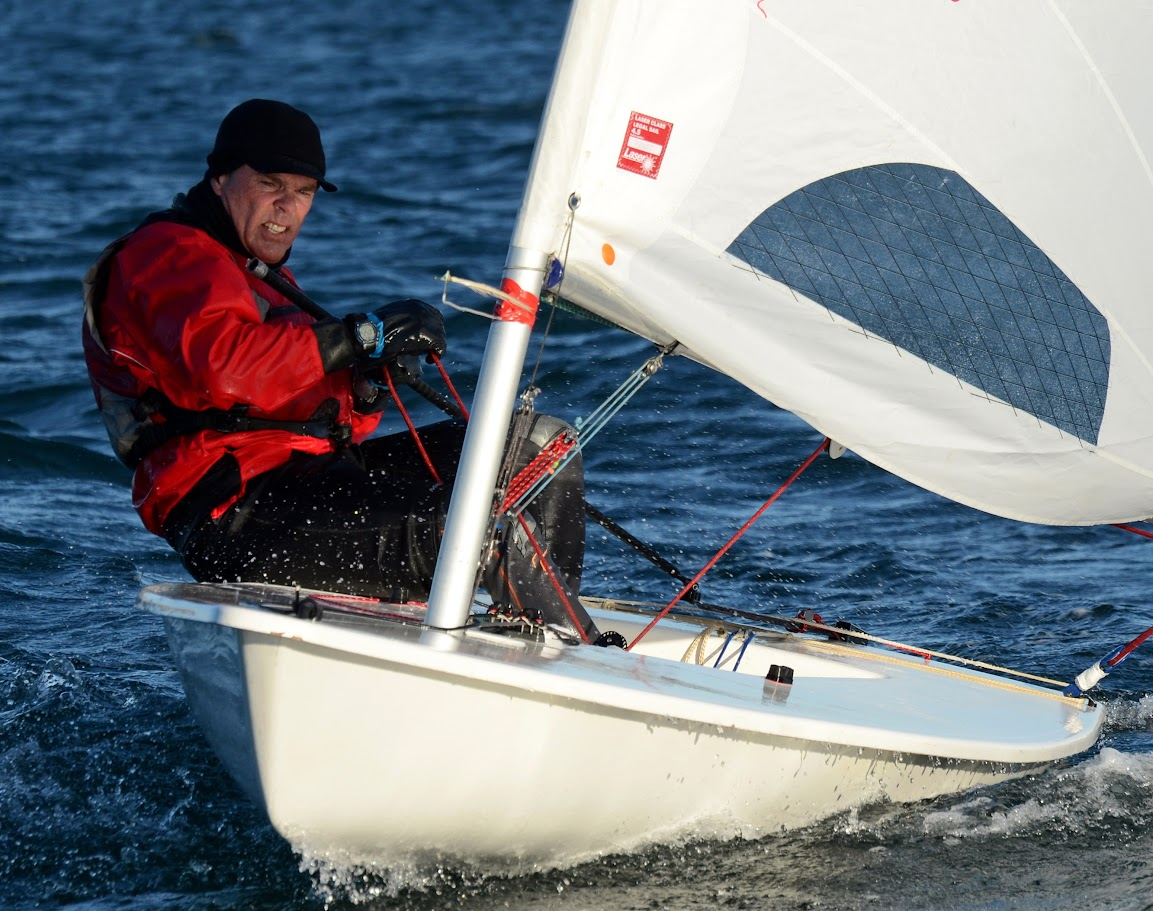
Ed seems to have a pretty repeatable pattern to frostbite racing:
Pre-start
• Check the course before the start to determine the start, current and favored end
• Check and re-check line sight from outside or just inside the windward end
• Determine where you want to go and where you need to start to get there
• Set up in time to ensure you will have a spot in the front row
• Do whatever you can to defend your hole
• Start bow-out on the guy next to you
First Beat
• Go fast to get into the front row (in heavy air this means HIKE)
• Make sure you play the little shifts – you need to take the lifts while not pinching
• Once in the front row execute on your plan – making sure you have a breeze lane
• If you can force people to go the wrong way while allowing yourself to go the right way, do so
• Constantly adjust your controls to maximize speed and pointing – vang on for puffs, off in lulls – same with the cunningham
• Sail the boat flat and make sure the board is down
Reaches
• Set yourself up to get the next big puff and get the inside overlap where possible
• Don’t heel to windward on the reach – it is slow
• Keep your fore-aft trim correct, forward in the lulls, back in the gusts
• Don’t fall asleep and let people roll you to windward.
• Pay attention to your telltales – there are major opportunities to gain by correct trim
Runs
• Sail with your weight as close to the middle of the boat as possible – this balances the boat for rhythmic movement
• Use your wind indicator and telltales to be sure you are either reaching or by the lee – dead downwind is painfully slow
• By the lee – ease your vang to free the leech and unbend the mast promoting reverse flow
• Reaching up – snug the vang and bend the mast to promote regular flow
• If you get out of control put the board down a bit and snug the vang a bit
Final Beats
• Round the leeward mark that is upwind of the other all else being equal
• Don’t overstand the finish line – tack when you get to the layline of the downwind end
The “Wind Jet”
1. Sunday’s weather seemed a little abnormal for Fleet 413. In those sort of situations, how do you sort out the sailing venue? What’s things are most important to figure out before the first race?
I checked the tidal current prediction (mostly slack) and the wind prediction (light/moderate northerly veering and dying) and temperature forecast (mid 50s) that morning (don’t want to overdress).
Typically, in this weather scenario, the left side has the pressure until the wind direction gets right of Goat Island, then the favored side flips to the right. But on Sunday, there was a cruise ship anchored upwind of Fort Adams–essentially a tall island between Goat and Rose– so the situation was unique.
A lot of guys get out early to sail an entire practice beat before racing. I usually leave the beach later (to stay warm), find someone to sail against on the way out (to check my settings) and then spend what little time I have checking the line. The guys practicing upwind give you a pretty good read on the range of shifts and pressure, which is nice of them.
The wind trended right all day, and so was furthest left in the first race. When wind has to flow around a tall obstruction (mountains, hills, or in this case, a cruise ship) it accelerates around the sides and leaves a hole downwind. The acceleration is called a wind jet. The taller the object, or the more stable the air, the more pronouced the jet.
In the first race, with the wind direction left, that hole behind the ship was lying close to the left corner of the course, and the wind jet off the right side of the ship was lying over the middle of our course.
But the pin was favored and port was the long tack. I started at the pin with Dave Moffet and everyone tacked almost immediately. Despite having a nice jump, everyone to leeward of me started to gain bearing, with more pressure, as I was too close to the hole. I just managed to round the first mark in the lead and overlapped with Dave. We jibed fairly early, afraid of the right side (facing downwind), only to watch as Ralph Kinder, alone, sailed down that side, around the fleet, to win the race easily. The wind direction had veered enough to shift the wind jet to Ralph’s side.
The next race, with the wind jet now lying over the left side (facing upwind) it was an all-left game. That same side was hugely favored both upwind and downwind….meaning it was all pressure. When the same side is favored up and down, it’s pressure. When opposites sides are favored up and down, it’s current.
This second race was twice around. On the long second beat, every tack to the right, even a very short tack, was a noticeably loss. The only trick was how to fit into the port layline parade to the weather mark, and it was there that I finally got back into the race.
In the final race, the wind had veered even further right and softened more. Now the wind jet had shifted off the course, and a new jet was forming to downwind of Goat Island, leaking right pressure onto the right side of the course. There was now a hole downwind of Goat Island lying across the left side of the course.
Andy Pimental, myself and PJ tacked early off the weather end of the line to arrive in the top 3 at the weather mark. We all jibed on the rounding, but lucky (for me) Andy flipped on the jibe and then plugged up the works behind me so I had an easy win.
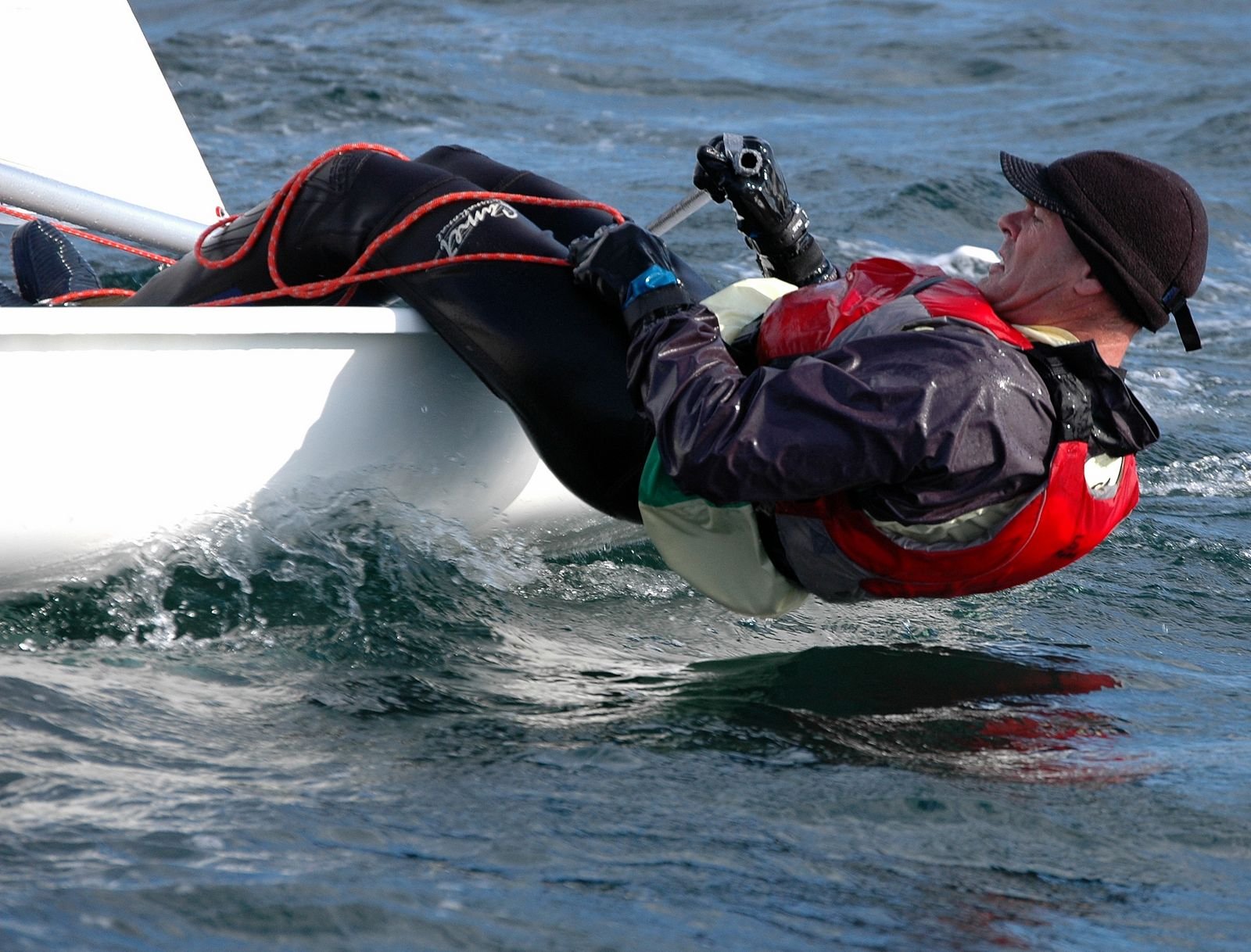
Sunday’s breeze was light, shifty, and variable in terms of windspeed. In these conditions, it seems like the ability to accelerate is key. How did you set up your sail so you were able to get through the lulls and build speed after altering course for a big windshift?
Nothing new about sail setup. I would refer to Moose’s words of wisdom on light air trim. He is really fast for his size in these conditions, and I just follow his advice.
But I do see that most people pinch in light air. Sure, you need to be able to sail high to hold your lane. But when there is no one on your lee bow, you’re lifted and/or on the long tack, let her rip.
Downwind in really light air can get really dull. But there are huge gains to be made for those who stay on their toes. What are two or three things that you focus on when going downwind in those really light conditions?
People fail to realize how long it takes to get moving if you let the boat stop. There is a correct angle to sail on the run for any given wind and wave condition, and if you are off angle, you can stop.
I spend a lot of time looking at the boats around me: -is someone in the same wind, sailing at a different angle making ground? If they’re gaining, match their angle. -is someone sailing at the same angle, gaining ground? If so, they have more wind. Get to that wind (heat up or jibe).
Expecting to do poorly. After my dismal performance at the BBR, I would have been happy with any finish in the top 10. High expectations tend to cloud your decisions and make it hard to sail conservatively.
